
What We Do
Mission Statement
The Mission of the Veteran Wellbeing Network Mid North Coast (VWNMNC) is to engage transitioning ADF personnel, veterans and their Families, to promote the family-unit’s wellbeing, resilience and self-sufficiency.
We will fulfil our Mission collaboratively, facilitating and monitoring support delivered by the Department of Veterans’ Affairs and other service providers in the provision of peer-to-peer support and social networking, and by raising the regional community’s awareness of veteran and family issues.
The VWNMNC is a collaborative initiative by a variety of Ex-Service Organisations within the Local Government Areas that constitute the New South Wales Mid North Coast. The VWNMNC uses a ‘hub and spoke’ model to deliver personalised Veterans advocacy support where the Veteran lives. There are three Veterans’ Wellbeing hubs: Coffs Coast VWC; Hastings VWC; and Midcoast (Taree) Veterans’ Wellbeing with each hub having a number of smaller ESOs and Advocates as the spokes.
Our Motto
Serving those who have served and their families.
Objectives of the Network
To provide a welcoming environment for all ex-service members and their families. The services that we provide include:
- A safe and secure support centre for wellbeing, advocacy and compensation.
- A quiet space with computer access for Advocates and Veterans and their Families.
- Peer support and mentoring with our “drop in” facilities.
- Referral service to health professional resources.
- Social support groups relating to veterans.
- Provision of activity based social events.
- Support for spouses and families of ex-service personnel and veterans.
- Support to all creditable Ex-Service Organisations, Advocates and Support Officers through advice, continuous professional development and networking and collaboration opportunities.
Come join us. We can help with a friendly chinwag or come and just relax and watch our large flat-screen TV and have some time out. The coffee is always hot and discussions are usually lively.
Goals for 2026
- To complete and share an integrated Veterans’ Wellbeing Management System – Ongoing.
- To collaborate with a variety of Ex-Service Organisations to develop a Network of Veterans’ and their Families service and support systems from the Clarence Valley to the Manning Valley – Ongoing.
- To actively petition the Federal, State and Local Governments for continued support to Veterans’ wellbeing – Ongoing.
- Establish and grow Network Veteran Wellbeing Centres at Coffs Harbour (Completed), Port Macquarie (Hastings – completed) and Taree (Completed).
- To connect with other ESOs both nationally and internationally – Ongoing.
- Establish relationships with community groups in the greater New South Wales Mid North Coast region – Ongoing and extended to national coverage.
Wellbeing Led Practice
The VWNMNC has adopted a Wellbeing-led approach to veterans’ advocacy, wellbeing support and service delivery. The Wellbeing-led approach is grounded on the seven wellbeing domains identified in the AIHW Veteran-Centred Wellbeing Model and subsequently adopted by the Department of Veterans’ Affairs (DVA) with a slight modification.
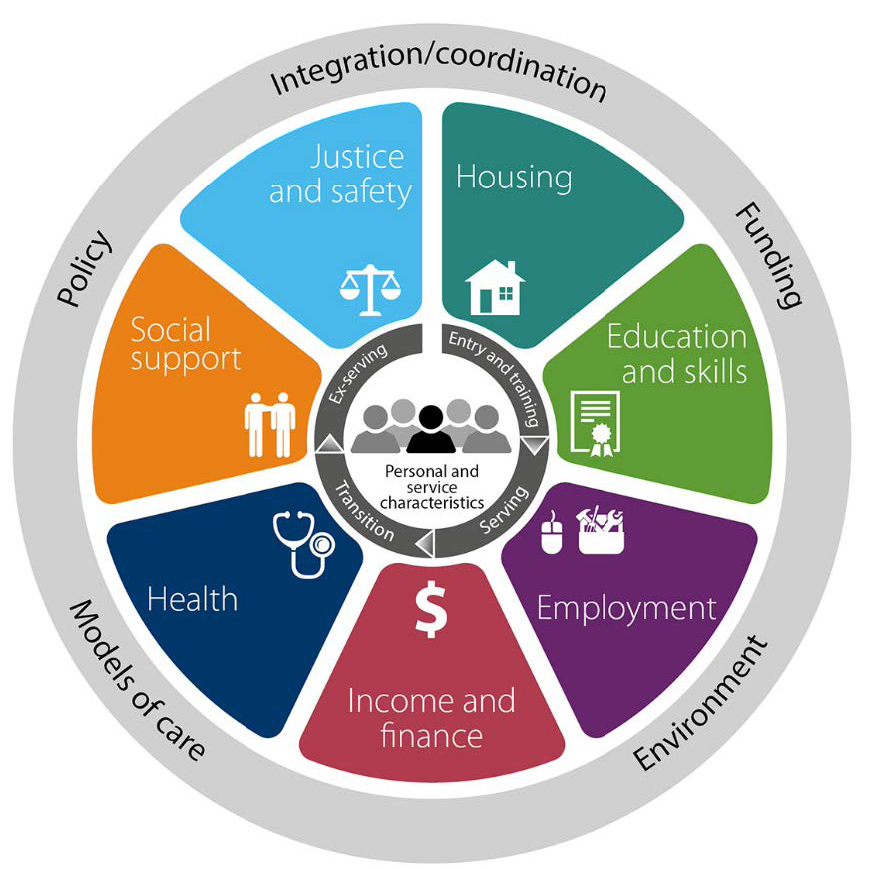
AIHW Veteran-centred Model
The concept of a Veteran’s Wellbeing is the focus of the Department of Veterans’ Affairs (DVA) as described in their Veteran Centric Reform. The reform of DVA is based on the collaboration of DVA and Australian Institute of Health and Welfare (AIHW). DVA and AIHW set up a three-year strategic partnership in 2017-18 to build a comprehensive profile of the health and welfare of Australia’s ex-serving (Veteran) population.
The seven domains are the coloured sectors and provide a framework which assists Advocates and Support Officers to formulate a Veteran Wellbeing Support Plan.
DVA Veteran-Centred Model
DVA has contextualised the AIHW veteran-centred model. DVA’s approach, based on the AIHW model, reflects the aspects of veterans’ lives that influence their wellbeing today and into the future. It includes assumptions that wellbeing is holistic, is centred on the individual, and changes across the whole-of-life continuum.
The model focuses on the experiences and outcomes for the individual, rather than on specific services or the broader health and welfare system. DVA focuses on the provision of support and services which aim to improve wellbeing outcomes.
The VWNMNC has used the Veteran wellbeing centred approach in our Programs to support Veterans, their Families and our communities.
The VWNMNC Advocacy Team
The underpinning logic is wellbeing support is “cradle-to-grave”, whole of person, whole of family reality. The Network’s objective is to have a Wellbeing Advocate/Support Officer and Compensation Advocate working together as an Advocacy Team.
A typical interview will have the Wellbeing Advocate/Support Officer conducting the interview and explaining their role with the Compensation Advocate note-taking and explaining their role. The Wellbeing Advocate works with the veteran to agree an initial Wellbeing Support Plan and implementation priorities.
Post-interview, the Wellbeing Advocate provides support directly to the Veteran, lodges NLHC for mental health, links the Veteran with Centrelink and other service provider(s) serving the general public, and guides the Veteran’s gathering of evidence required to lodge a claim for liability. The Wellbeing Advocate also keeps the Support Plan in continual review.
Throughout the period of contact with the veteran, the Advocacy Team will keep in touch with each other either face-to-face or by monitoring the Client File until the veteran is ready to work with the Compensation Advocate to prepare the statement(s) of attribution and lodge the claim/appeal. In unison with the development of the claim(s) the Wellbeing Team provides continuous support to the Veteran and their Family.
Our Constitution and By-Laws
Click the following links to view our Constitution and By-Laws.

